On various socials, I’ve seen a lot of discussion on various uses of generative AI, from the announcement of Jorge R. Gutierrez’s AI animation deal with Amazon/MGM to the revelation that Martin Scorsese is now using it to this quote from a New York Intelligencer article (paywalled):
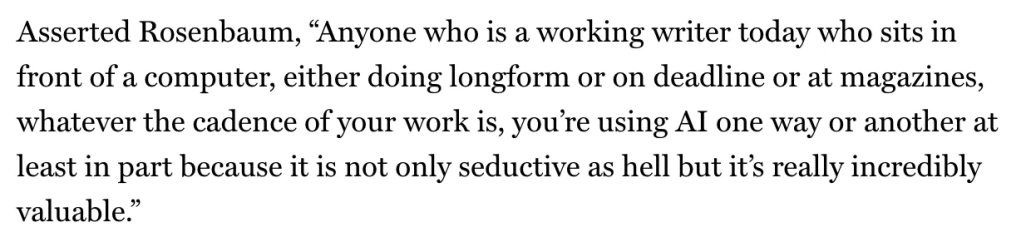
This quote is meant to refer to the workflow of nonfiction authors, specifically journalists, and I get why the quote-writer thinks this. From their perspective, it makes everything faster, which means you can get to market faster, and that’s critical for their business in these times.
Except the quote assumes that AI works like the marketing promises.
It doesn’t. It is a machine designed for sycophancy, presenting whatever will please the people that engage with it, riddled with inaccuracies, biases, and lies. Any working writer with a background or interest in technology knows this, and many don’t like it. While they might be forced to use it, they’re certainly not happy about it, and they don’t view it as “incredibly valuable.”
As much as possible, I don’t use AI1. I don’t use AI to create. I don’t use it to research, or edit, or polish (to my knowledge2). I don’t use it for covers or anything else related to the book. I probably never will, even if they somehow manage to fix all the problems of consent3 from ingested creatives and environmental impact and the actual living cost for all of this data processing.4 I don’t use AI for one simple, really specific reason.
It’s not as good as I am at my stories. It never will be.
I know that might come across as arrogant, but it’s true. It’s true for you as well. Once you build your real skills, AI will never be as good as you are.
I have one great example, right here on this site. I was brainstorming with the Tanglemark folks to come up with a virtual book launch, knowing I’m a debut author with very little following. Most book launches are in-person, at a bookstore or at a location that is relevant to the book’s topic, and we don’t have the marketing budget for anything like that. We knew very few folks would attend a Zoom or Meet party that was just “the brand-new author, talking.” So what were we going to do?
Anything AI would come up with would be something that had already been done. By definition. AI can’t come up with something new because those services only have access to what’s already been done in their data set.
AI would never have come up with “Your main character is an event planner – write something up that mimics her doing your launch party and post it on socials.”
AI most likely wouldn’t have come up with the parties Viyana plans in the book. AI wouldn’t do Dash’s awesome snark. AI wouldn’t do Cory’s obsession with consent. AI wouldn’t come up with the same jokes.
Most importantly? AI wouldn’t care about these characters. If anyone or anything is going to be a co-writer with me, they have to care. Because otherwise, they’ll suggest things that don’t fit, and if I’m not writing it, I’ll miss it when I’m rereading, the same way I miss typos.
I know a lot of people are under a lot of stress, trying to keep their jobs in a fraught market. I don’t hate anyone who is using AI just to stay employed or keep their head above water. I’m incredibly privileged to be able to say no, and I’m incredibly lucky that I write quickly. I’m also willing to admit that I tried AI, early on. I tried Midjourney and Sudowrite and OpenAI. I honestly thought they were using public domain work, not copyrighted works, because I used to work in creative digital technology, and that was what legal demanded when we were building datasets. All open source, Creative Commons, or public domain. So once I knew, I noped the hell out.
Many people are still ignorant of how bad AI actually is. But some people know, and still use AI when they don’t need to, when it isn’t critical to make their living. Why would they care that AI is run on stolen creative work, if it gets them what they want?
I can’t be that person. I hope my readers aren’t those people either.
- I’m being forced to use AI whenever I use Google search, EVEN IF the results are hidden with parameters, and I hate that. I really wish DDG and Brave searches were better. I also am forced to use AI on my devices, no matter how often I turn it off. I cannot wait for this bubble to pop. ↩︎
- With all of these technology companies shoving AI in their systems without telling us, I might be using AI without my consent just by posting this or publishing my work, and that’s part of the core problem. ↩︎
- Consent is incredibly important to me, and every AI service out there has almost none from its sources, and their consumption doesn’t fall appropriately under the Fair Use doctrine the way that quote above does. I know this because I used to work in tech, and we had to prevent consumption of whole works vs 100 words, regardless of whether or not that whole work could be replicated. ↩︎
- It’s incredibly expensive to run data centers, and making a profit in that industry will take trillions of dollars, which will have to come from us, one way or the other. ↩︎


Leave a Reply